
What the scheme covers
One of the compliance considerations when operating a business in China is the Social Security responsibilities relevant to employment. The Labour Law, enacted in 1994, and the Labour Contract Law established the main framework of the scheme. Social security consists of pension, work-related injury, unemployment insurance, medical insurance and housing fund. The previous maternity insurance now comes under medical insurance.

Rates are set city by city
The exact percentages of each category vary at the discretion of the Social Security Bureau and Housing Fund Management Centre in each city. To make social insurance contributions, employers register new employees with the corresponding bureaus. Employees and employers are both required to contribute to the social security and housing fund account of the employees, although foreign employees are exempt from the housing fund.
Foreign employees: from discretion to compliance
There has never been ambiguity over social security contributions for Chinese employees: they have always been required to contribute jointly with their employer, whereas the practice for foreign individuals was not uniform across China.
The inconsistency, since 2009, between Shanghai and national rules on social security contributions for foreign employees created room for interpretation. In most cases employers naturally opted out of contributing for foreign staff. The notice issued by the Shanghai Municipal Bureau of Resources and Social Security was extended in 2016. As the previous social security announcement for foreign nationals expired on 15 August in Shanghai, expats are left with no discretion: they must contribute to their social security account.
Shanghai social security reference table
| Chinese Nationals | Foreign Residents | |||
|---|---|---|---|---|
| Individual | Employer | Individual | Employer | |
| Pension | 8% | 16% | 8% | 16% |
| Work-related Injury | N/A | 0.16% – 1.52% | N/A | 0.16% – 1.52% |
| Unemployment Insurance | 0.5% | 0.5% | 0.5% | 0.5% |
| Medical Insurance | 2% | 10.5% (including 1% from maternity insurance) | 2% | 10.5% (including 1% from maternity insurance) |
| Maternity Insurance (being included under Medical Insurance as of 2020) | N/A | N/A | N/A | N/A |
| Housing Fund (not required for expats) | 5 – 7% | 5 – 7% | N/A | N/A |
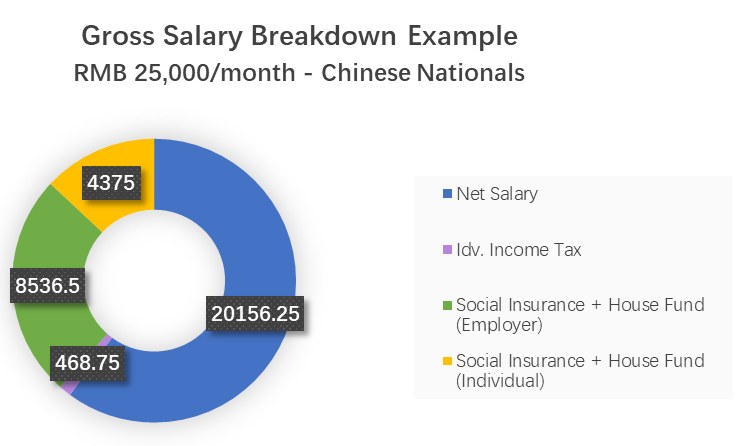
What a RMB 25,000 package looks like
The pie chart above shows the composition of a gross salary of RMB 25,000 a month, assuming the housing fund percentage is 7% and work-injury insurance 0.25%. Housing fund percentage is determined by the employer whereas work-injury insurance is decided by the Bureau.
Housing fund contributions are not required for expats, so the composition of the package changes slightly, as below.
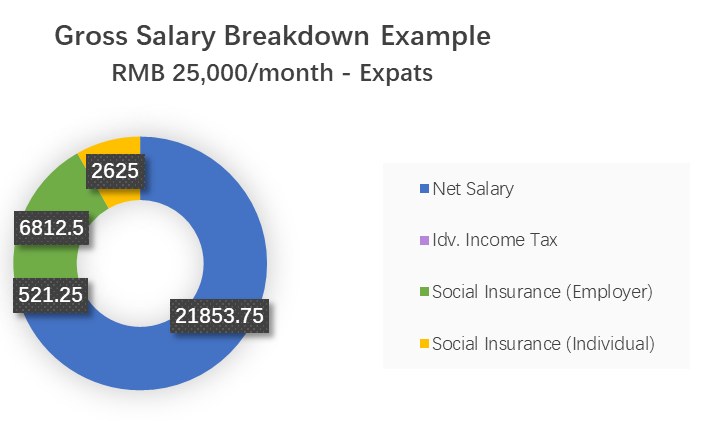
What the change costs
With the reinforcement of social security contribution for foreign employees, the cost of employment is now higher, leaving it almost identical to hiring local staff. With more foreign employees working and retiring in China, the social insurance scheme provides security for the individuals and order for the government.
Leaving the city, or the country
Under the circumstances of the employee leaving the current city or China, the personal contribution to the social security account is available for withdrawal. The employer’s contribution may be transferred to the destination city (possible between certain cities) or deemed forfeited.
Compliance is one of the baselines for success in operating a business in China. “Integrity, efficiency, clarity” is the value proposition of STAR Accounting & Consulting. With 15 years of servicing foreign clients from around the globe, understanding profoundly what our clients are looking for, we thrive on providing advice with clients’ best interests at heart. Should you have any further questions on employment, social security, payroll or other aspects of your business, please do not hesitate to contact us at sales@star-acc.com.