
Profit and profitability are not the same
One of the paramount criteria for whether a company is operating successfully is its profitability. The ability to generate profit is usually the first thing to consider. Although the two terms are often used interchangeably and are both accounting metrics for analysing the financial well-being of the firm, they are distinctly different.
Profit is the total revenue minus total expenses and will appear on a company’s income statement.
Profitability is a relative term instead of an absolute figure, which is the measurement used to determine the scope of a company’s profit in relation to the size of the business. It is a reflection of efficiency essentially and ultimately a verdict of success or failure. While a company can realize a profit, this does not necessarily mean that the company is profitable.
A profitability analysis is necessary to understand whether the company is using its resources and capital efficiently. Usually, one of the first things and the most straightforward aspects analysts — and, in turn, accounting specialists will assess is the profit margin.
Profitability – profit margin
Profit margin, presented as a percentage, indicates how many cents of profit have been generated for each dollar of sale. The different profit margin ratios reflect the profitability on the different levels of cost, among which the Net Profit Margin represents the bottom line of the company after taking out all relevant expenses and costs.
Internally, business owners, management and external consultants use it to address operational issues and to identify seasonal patterns and performance. Externally, creditors, investors and management use profit margins as parameters for financial health, management competence and growth potential.

Gross profit margin
Gross profit margin measures how much a company makes after accounting for Cost of Goods Sold (COGS). It is most useful on a per-product basis, where it reflects the profitability of the product range.

Operating profit margin
Operating Profit Margin, also referred to as Return on Sales, indicates how well the company is managed and how efficiently it generates profit from sales. It is more detailed than the gross margin, showing the share of revenue available to cover non-operating costs such as interest. This is why investors and lenders pay close attention to it.
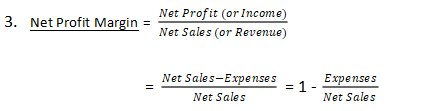
Net profit margin
One of the most significant measurements of profitability – a company’s bottom line after all other expenses (including taxes and one-off payments) being removed from revenue. If a firm records net sales of RMB 100,000 in a quarter and spends RMB 80,000 in total on expenses, the net profit margin is 1 − (80,000 ÷ 100,000) = 0.2, or 20%.
The higher the percentage, the better the profitability. And the last variation has intuitively indicated that either by reducing expenses or by boosting sales, raises the net margin.
Application of profit margin
Theoretically, there are a few levers for the management or business owners to achieve higher profit margins: increasing price, increasing the volume of units sold, expense control or the different combinations of the above. In practice, each has an upper limit. Prices can only rise as far as the competitive edge allows; sales volume depends on market demand, competitors’ positions and the market share the business commands; cutting an unprofitable product line may mean losing the corresponding sales.
Therefore, improving the profit margin is a fine balancing act between price, volume and cost control. It is an indicator of how adept the owner or management is at pricing for higher sales while controlling cost efficiently.
Comparing profit margins
The caveat is that profit margin is used comparatively, while every business has its own operation and profit-generating strategy. The ability to generate high revenue does not necessarily translate into profitability.
Businesses with lower profit margins (retail, nail salons, transport…) have high turnover, which produces high profits despite the low margin figure. Microsoft and Alphabet generate high double-digit quarterly profit margins, while Walmart and Target achieve single-digit ones. It should not be concluded that the latter two are less successful than the former two. Profit margin analysis must be handled with care when compared across businesses and industries. The cash flow involved in each deal, the volume of transactions and the size of the industry should not be taken as synonyms for profitability. A nail salon might just be as profitable as a mid-tier accounting firm – after all, there must be some reasons for them to be EVERYWHERE! 😉